
By Carlin Felder, Licensed New York Real Estate Salesperson and author of Social Media Made Easy
You posted the listing photos. You made the Instagram Reel. You shared the market update on Facebook. Maybe you even spent an hour making a carousel in Canva.
And then nothing happened.
No calls. No messages. No new buyers or sellers asking for help.
If you’re a real estate agent trying to figure out how to get clients from social media, you’re probably wondering whether you’re wasting your time.
Here’s something worth understanding: Posting more content isn’t necessarily going to bring you more clients. You need to know who you’re talking to, what they’re looking for, and how to create content that makes them want to reach out.
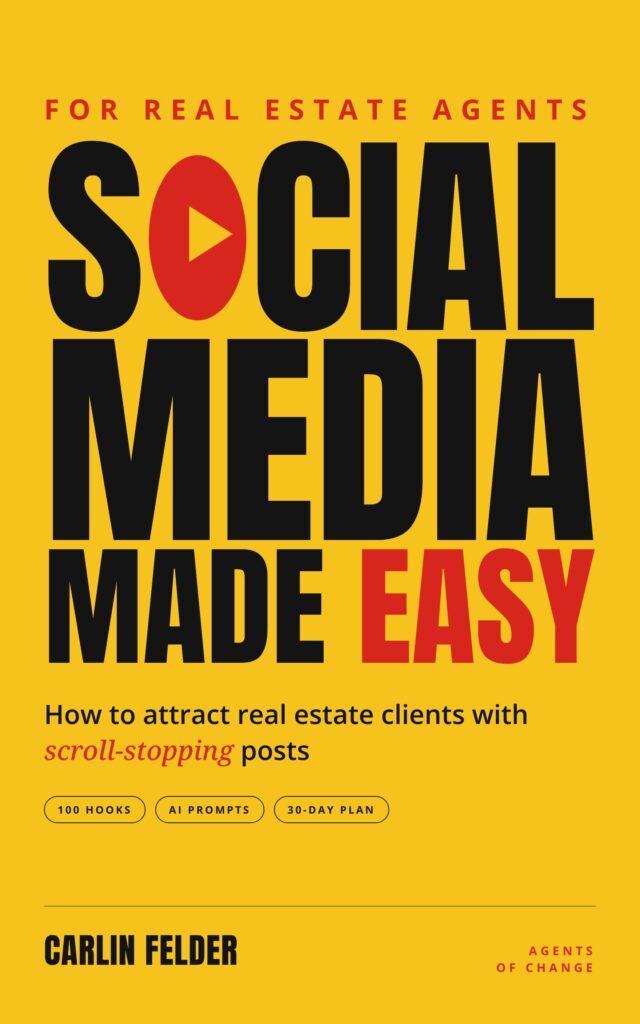
That’s why I wrote Social Media Made Easy: How to Attract Real Estate Clients With Scroll-Stopping Posts.
It’s a practical guide for new agents, part-time agents, full-time agents, and experienced REALTORS® who want a better way to market themselves on Instagram, Facebook, and YouTube.
The book includes 100 fill-in-the-blank social media hooks, AI prompts, content strategies, video and carousel instructions, worksheets, and a 30-day starter plan.
Why Is Social Media So Difficult for Real Estate Agents?
The National Association of REALTORS® reported in its 2025 Technology Survey that 75% of REALTORS® use social media. It also found that 39% identified social media as their leading technology source for quality leads.
But using social media doesn’t automatically mean you’re getting business from it.
Agents are constantly trying to solve the same problems:
- They don’t know what to post.
- They spend too much time creating content.
- They’re uncomfortable talking on camera.
- Their posts get views but generate no inquiries.
- They don’t know whether Instagram, Facebook, or YouTube deserves their attention.
- They struggle to post consistently while managing clients, showings, and transactions.
- They don’t know how to turn followers into actual conversations with buyers and sellers.
I understand these frustrations because I’ve experienced many of them myself.
I’ve been a licensed real estate agent in New York since January 2019. During my first several years, I relied heavily on traditional prospecting methods and the lead opportunities available through my brokerages.
Eventually, I began investing more time in building my own online presence.
YouTube made the biggest difference in attracting people who were searching for information about the Hudson Valley. Instagram helped me establish new connections, and Facebook helped keep me visible to people who already knew me.
The most rewarding part was having potential clients contact me because they had watched my videos and wanted my help.
That experience changed how I thought about real estate marketing.

1. Stop Posting Random Content and Start Answering Real Questions
One of the biggest mistakes agents make on social media is posting whatever comes to mind.
A new listing. A motivational quote. Another market update. A closing announcement.
There’s nothing inherently wrong with any of those posts. But they don’t necessarily answer the questions potential clients are asking.
Think about the people you want to work with.
Someone who inherited a property might be searching for information about selling a parent’s house.
Someone planning to relocate might be researching the pros and cons of living in your town.
A homeowner approaching retirement might be wondering whether downsizing actually makes financial sense.
These are real estate content opportunities.
In Social Media Made Easy, I explain how to identify your ideal client by their situation and find the questions they’re already searching for.
You can research those questions using Google, YouTube autocomplete, Google Trends, Reddit, and local Facebook groups.
Instead of guessing what people want to know, you can create content that answers questions they’re already asking.
2. Learn How to Write Social Media Hooks That Get Attention
You can have the best information in the world, but if someone scrolls past your video in the first few seconds, they’ll never hear it.
That’s why an entire section of my book is dedicated to writing better hooks.
A hook is the opening line, visual, or statement that makes someone stop scrolling long enough to pay attention.
For example, consider these two approaches.
Generic real estate content:
“Here are some things to think about before selling your house.”
A more specific hook:
“Thinking about downsizing? The smaller house might actually cost you more money.”
The second example gives the viewer a reason to keep watching.
It identifies a specific situation, introduces something unexpected, and promises useful information.
The book teaches a three-line hook formula, six different angles for approaching a topic, and the common reasons people scroll past real estate content.
It also includes 100 fill-in-the-blank hooks that agents can adapt to their own markets, listings, buyers, and sellers.
If writing the first sentence of a Reel takes you longer than filming it, this section is particularly useful.
3. You Don’t Have to Be Comfortable on Camera to Get Started
One of the most common obstacles to creating real estate videos is simply not wanting to be on camera.
I understand that.
Not everyone wants to sit in front of a ring light talking into a phone.
And not everyone has the time or interest to become a full-time content creator.
Fortunately, you have other options.
In the book, I explain several content formats that real estate agents can use:
Talking-head Reels: Short videos where you explain one useful piece of information directly to the viewer.
Instagram carousels: Swipeable posts that teach something, compare options, or break down a complicated subject.
Text Reels: Short clips of homes, neighborhoods, or everyday real estate activities with text on screen instead of narration.
Walk-and-talk videos: Videos filmed while you’re exploring the communities where you work.
YouTube videos: Longer educational content designed to answer questions people are actively searching for.
You don’t need an expensive camera or an elaborate production setup to start.
You need something useful to say, a clear way to communicate it, and a format you’re willing to repeat.
4. Use YouTube to Build a Library of Real Estate Content
One of the reasons I like YouTube for real estate marketing is that people use it to research major decisions.
They’re not necessarily looking for a real estate agent when they begin watching.
They might be researching neighborhoods, home prices, property taxes, commuting options, or what it’s like to live somewhere.
That’s an opportunity to introduce yourself before they need an agent.
For example, a video titled “Moving to Beacon, NY? Five Things to Know Before Buying a House” addresses a specific question from a potential buyer.
The video becomes part of your online library of local expertise.
In Social Media Made Easy, I explain how to identify searchable video topics, structure shorter educational videos, and use AI tools to help organize your content.
You can also repurpose one longer video into several short clips for Instagram and Facebook.
That allows you to build content around your actual knowledge instead of starting from scratch every day.
5. Use AI to Create Social Media Content Without Losing Your Personality
Artificial intelligence can be useful for real estate agents who struggle with writing captions, developing video ideas, or organizing a content calendar.
But AI should help you communicate what you know. It shouldn’t replace your experience or invent information about your market.
The 2026 NAR Technology Report found that among agents using AI, 56% used it for social media posts.
In the book, I include practical guidance for using AI to improve hooks and create carousel designs. The prompts help agents develop content while maintaining control over their messaging.
For example, you can use AI to organize information into a seven-slide Instagram carousel with clear headlines, consistent formatting, and a call to action.
You can also ask AI to improve a video’s opening sentence while preserving the meaning of what you want to say.
The goal is to spend less time staring at a blank screen and more time putting your real estate knowledge to work.
6. How Often Should Real Estate Agents Post on Social Media?
There isn’t one posting schedule that’s appropriate for every real estate agent.
A part-time agent with another full-time job has different time constraints than an experienced full-time agent with administrative support.
My approach is to build a schedule you can maintain.
The book offers two levels of content production.
The minimum schedule:
Three social media posts per week, plus one Google Business Profile post.
The full content system:
One YouTube video per week, three to five short video clips, five social media posts, and one Google Business Profile post.
I also recommend batching content so you’re not trying to figure out what to film every morning.
For agents who are just getting started, consistency with a manageable schedule is much more useful than creating an ambitious plan that becomes impossible to maintain.
The book includes a 30-day starter plan to help establish that routine.
7. The Goal Isn’t More Followers. It’s More Conversations.
One of the most important lessons I’ve learned from using social media in my real estate business is that followers don’t necessarily equal clients.
You can have thousands of followers who will never buy or sell a property in your market.
You can also have a relatively small local audience that includes past clients, neighbors, friends, potential sellers, and people preparing to relocate.
Those relationships can be much more valuable.
Your social media content should accomplish two things.
First, it should remind people who already know you that you’re active in real estate and understand your market.
Second, it should help new people discover you when they’re searching for information about buying or selling.
But getting someone’s attention is only the beginning.
You also need to make it easy for them to start a conversation.
The book covers how to write one clear call to action, respond to comments, move conversations forward, and measure whether your content is producing meaningful business opportunities.
Instead of focusing entirely on likes and views, start paying attention to inquiries, conversations, appointments, and clients.
Those are the numbers that matter to your business.
What’s Inside Social Media Made Easy?
Social Media Made Easy: How to Attract Real Estate Clients With Scroll-Stopping Posts is organized into four main sections.
Part One: Strategy
Learn how to identify your ideal client, research what potential buyers and sellers are searching for, establish content pillars, and create a manageable posting schedule.
Part Two: Hooks
Learn how to write better opening lines, use visual hooks, approach topics from different angles, and improve content that isn’t holding people’s attention.
Part Three: Making the Content
Step-by-step guidance for talking-head Reels, Instagram carousels, text-based videos, walk-and-talks, and YouTube videos.
Part Four: Turning Views Into Clients
Learn how to create calls to action, turn comments into conversations, develop a repeatable content process, track meaningful results, and follow important real estate advertising guidelines.
The book also includes 100 fill-in-the-blank hooks, a hook worksheet, additional worksheets, and a 30-day starter plan.
Frequently Asked Questions About Social Media for Real Estate Agents
What should a new real estate agent post on social media?
Start by answering questions first-time buyers, sellers, and people relocating to your market are asking. Explain the buying process, discuss local neighborhoods, share property insights, and introduce yourself through useful educational content.
Can real estate agents really get clients from Instagram?
Yes. Instagram can help agents stay visible to their existing network, build relationships, demonstrate expertise, and attract new inquiries. Results depend on audience relevance, content quality, consistency, and follow-up.
Is Facebook or Instagram better for real estate agents?
Both can be useful for different purposes. Facebook can help agents maintain connections with their existing sphere of influence and local communities. Instagram can help agents reach additional people through Reels, carousels, and visual content. Choose based on where your intended clients spend time.
Is YouTube worth it for real estate lead generation?
YouTube can be particularly useful for agents who want to attract buyers researching a specific location. Videos answering detailed local questions can remain discoverable after publication, although results depend on search demand, competition, and content quality.
How can a real estate agent create social media content with AI?
AI tools can help brainstorm topics, revise hooks, structure video scripts, develop captions, and organize carousels. Agents should review all AI-generated content for accuracy, local relevance, their own voice, and advertising compliance.
How do I get real estate leads from social media without paying for ads?
Focus on answering specific buyer and seller questions, producing searchable local content, building relationships with existing contacts, and giving interested viewers a reason to contact you. Organic lead generation takes consistent effort and doesn’t guarantee inquiries.
What are good social media hooks for real estate agents?
Effective hooks identify a specific problem, question, or unexpected insight. Examples include “Three things to check before selling your home” and “Moving to [TOWN]? Here’s something you should know about property taxes.”
What’s a good social media book for new real estate agents?
Social Media Made Easy by Carlin Felder is written for agents who want practical instruction on creating Instagram, Facebook, and YouTube content. It covers audience strategy, video hooks, content production, AI assistance, calls to action, and a 30-day starter plan.
Ready to Make Social Media Work for Your Real Estate Business?
If you’ve been struggling with what to post, how to make videos, or how to turn social media attention into real estate conversations, I wrote this book for you.
You don’t need to become an influencer.
You need a way to share what you know about real estate, help people understand their options, and make it easier for potential clients to find you.
Social Media Made Easy: How to Attract Real Estate Clients With Scroll-Stopping Posts gives you a place to start and a system you can build on.
Get Social Media Made Easy by Carlin Felder on Amazon.
Buy your copy now >> https://link.amazon/B009cSpFJ
Follow me on YouTube: https://www.youtube.com/@agentsofchangerealestate
About the author: Carlin Felder is a licensed New York real estate salesperson, photographer, and author who has worked in real estate since 2019. Based in the Hudson Valley, she creates educational resources to help agents develop their own marketing strategies, build an online presence, and attract business through organic content and local expertise.